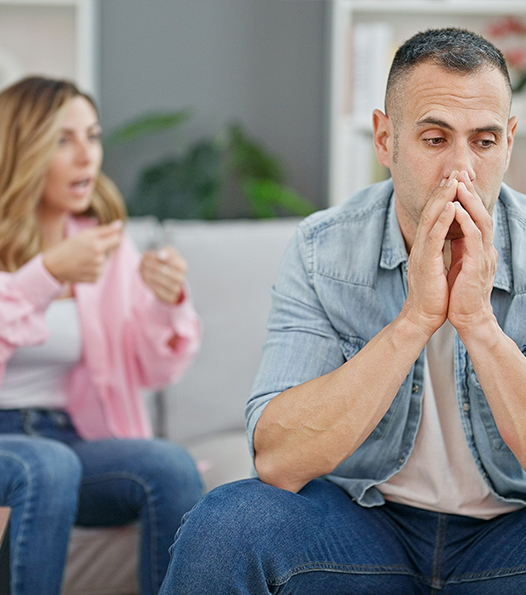
The issue is bigger than arguing.
The same fight keeps happening, only with different details, and the issues are starting to get out of hand.
One of you pushes for answers, clarity, or change, and the other shuts down, withdraws, or avoids making things worse.
The more one of you pushes, the more the other pulls away, until both of you feel exhausted, frustrated, and alone.
It’s not just communication. It’s an emotional disconnection.
Most couples in conflict are told they have a “communication problem,” but that’s only part of the story.
Underneath the anger, defensiveness, or silence, deeper emotions are trying to be heard: “Do I matter to you?” “Am I enough?” “Can I trust you to be there for me?”
When those questions feel uncertain, your relationship becomes unsafe, and that’s when the conflict escalates.
What’s happening is a pursue-withdraw cycle.
From an attachment perspective, couples in conflict often fall into a pattern: one partner pursues by asking questions, raising concerns, and pushing for change, while the other withdraws, shuts down, avoids, or tries to keep the peace.
Neither of you is wrong.
You’re both responding to the same underlying fear of losing connection with each other, but the way you protect yourselves ends up creating more distance.
When attachment bonds feel threatened, our nervous system reacts quickly.
Small moments can feel big, neutral comments can feel critical, and silence can feel like rejection.
You may find yourselves reacting in ways that don’t even make sense to you afterward.
That’s because conflict in relationships isn’t just logical. It’s emotional and deeply wired.

Break the pursue-withdraw cycle.
In our work together, we don’t just focus on stopping arguments. We focus on understanding what’s happening underneath them.
Through therapy, you will begin to recognize the cycle you’re both caught in, understand the deeper emotions driving your reactions, slow down conflict as it’s happening, and share what you’re really needing in a way your partner can hear.
Instead of reacting automatically, you’ll start responding with intention, going from protection to connection mode.
As you begin to understand each other differently, something shifts.
The partner who felt critical starts to feel vulnerable, and the one who withdrew begins to feel safer to engage.
You stop seeing each other as the problem and start seeing the cycle for what it is.
Now, you’re both trying to hold onto the relationship, even if it doesn’t look like it.
Conflict, in many ways, is a protest of disconnection. It’s what happens when something important between you feels at risk.
When we can slow that down and make sense of it together, you can begin to reach for each other in a new way.
Connect and reduce the conflict.
You don’t have to keep having the same fight over and over, or to feel like you’re walking on eggshells, or like nothing ever gets resolved.
There is a way to feel heard, understood, and connected again.
If you’re feeling stuck in conflict and don’t know how to change it, I’d be glad to help.
Reach out to schedule a free 15-minute consultation, and we’ll talk about what’s been happening and what the next step could look like.